I have managed multiple teams during my career so far, these teams focused on a mix between operations, trust and safety, product and analytics. I have been extremely lucky to have 95% of my line managers be excellent leaders and those folks have taught me invaluable lessons. I have found these areas to be valuable to me when leading a team, reading a bunch from this list and realising as a leader it’s your job to work for your direct reports. I am finally getting to document some learnings!
What’s your motivation to make the jump into people management?
Don’t get caught in the “it’s a great next step” trap
At least 80% of people I have managed have told me they want to move into people manage to develop, it usually comes up in our first discussion of career goals. When I ask Why? they will have a mixture of feedback that will often include the following themes:
“I want more responsibility”, “I more say in the direction of my career” “It’s the next logical step for my development”, “it’s what I have always wanted”,”I’m doing it already in theory (they usually aren’t)” “it’s the only way for me to move up” “I like delegating”.
Can you see what’s missing ? The ‘People’ element, should be a motivator to be a people manager should be the IC wants to move into management and develop and lead people. If ICs become managers too early and the motivation is any of the reasons above, the result is a high performing IC who can’t and don’t want to deal with nurturing talent. In some cases I’ll concede it can work but it’s a steep learning curve.
Opportunities to advance within an organisation can lead to professional growth, but ICs should consider their true motivations before seeking management positions. I have lived by the mantra: “You need to develop horizontally before you can move vertically”
If people management is your goal you need to have the correct motivation for it and to be truly good at it, you need to care about developing your team and fostering a positive culture.
Being a people manager
Public Speaking
How are people going to trust and follow you if you can’t present well? If you are uncomfortable speaking in front of a group, do what you need to and make it work for you. I was not a fan of public speaking at all, it’s still not something I’ll jump for joy at but I’ll rally because it’s my job.
Type / write your speaker notes on another device or paper and read from that during your presentation. This will give you that safety net and reduce the need for improvisation.
Practice your presentation or difficult conversations multiple times. Ensure, if you are reading from speaking notes you are prepping your pauses and tone etc.
Record your practice sessions (Mortifying at the best of times, it does help weed out the “ehms”” and useless jargon).
Practice answering difficult questions: Work with a colleague or alone and formulate the most difficult questions you can think of and prep answers for this. This will give you an extra air of confidence that you can manage even the most difficult questions.
Do not speak on something you are not well versed in, there is nothing worse than a leader presenting on something they have no context on.
Trust & Transparency
Be as transparent as possible with your team. Address rumors and uncomfortable subjects head on. If your team has been set a box ticking exercise, better to tell your team head on and move through it together and onto the next. If you notice something in your ICs behavior that is impacting their work or has the potential to impact their work in the future, address it head on.
Example: A previous manager of mine was able to pick up on my poor written communication pretty quickly, we worked together to solve it. Turns out I am dyslexic but, with this level of trust and transparency, I was able to get a diagnosis and put some minor adjustments to my work day in place to address it (color coding docs for reading & installing Grammerly / other AI apps).
Transparency builds trust but some other ways of building trust are: Having your team’s back, be firm but fair, don’t over promise and under deliver, deliver on time particularly to your team.Work to fix key areas impacting their work example: If a particular team is causing undue work for your own team, fix this issue so they can focus on their most impactful work.
Have your team’s back
As a manager, you need to have your team’s back and you need to be brave. You will have uncomfortable conversations with other leaders about your team, you will have uncomfortable conversations with your own team, you will have uncomfortable conversations with your own manager about your team. Know when to pushback (pick your battles) and when to concede. You don’t need to in ‘all guns blazing’ all of the time (something I learned can be disastrous very early on) but, you need to be able to engage in those uncomfortable conversations and hold your own for the sake of your team and yourself. When you do need to really go in full force - know your facts, know your audience and know the amount of sway you have in the conversation. I have found that the best leaders are ones who can balance all of this well. On balance, you also need to know when to hold your team to account in situations and not be blinded by loyalty.
Be a leader not a manager
Yes, there’s a distinction here. A manager can sort out your day to day work give you instructions and help you fix issues and approve your annual leave. A leader will pave the way for your team and your own development, they will also lead by example and expect high standards, they will have a vision for you and for your team. They will go out on the limb to get your team visibility and context and most of all, they’ll lead your team through complex issues in a positive way. Transitioning from a manager into a leader comes with time, learning and constant feedback from all angles.
Learn how to manage performance and how to calibrate effectively
Truly managing performance can be challenging. You can give an IC the clearest blueprint to improve their performance and they many still not be able to accomplish the goals and that’s ok it’s your job to work through it. You’ll be exposed to a bunch of different abilities (some typical examples below):
High impact performer with big ambitions
High impact performer who has plateau’d
High impact performer with weak communication skills or behavioral issues
Medium performer with some behavioral issues
Low impact performer with a lack of motivation
Low impact performer and great team player
For each of these classic examples, ensure you are able to bring your IC through these challenges. ICs can often go across each of these categories (as well as others) throughout their career. Knowing when an IC has shifted between is key, if you catch 2,4,5 early they are usually an easy fix (in terms of shorter turnaround).
Performance management should be continuous. There shouldn’t be any surprises for ICs when they receive their performance rating. If there is a surprise, you have not done your job correctly (harsh, but true). Keeping the conversation open throughout the weeks and months for performance conversations is invaluable. Encourage your ICs to tell you if they are at a low level of motivation and why.
Calibrations: I have seen this calendar invite strike fear into the hearts of many. Three things you need to ensure you have covered:
Your ICs actual true performance and behavior: You need to be fair when reviewing your ICs performance. Seeing their review before they submit will often allow you to weed out the embellishments. Embellishments don’t (or shouldn’t) fly at a calibration session. Ensure both you and the IC are being realistic. If you are overrating or underrating ICs in reviews, it’s going to result in a few of negative outcomes:
1) Lack of rating fairness / consistency across not just your team but the wider teams.
2) Lack of trust amount other leaders if you are consistently not consistent with your ratings.
3 ) Overrating: False sense of security for the IC.Awareness of organizational performance rating model : Every company has a performance rating model and guardrails within, there is also likely a rating compliance system this is normal for every company and not something to fall back on in terms of why are you are rating they way you are. Examples: After your first cycle it’s likely impossible to get the highest rating possible coupled with a promotion. These guardrails are there for managers to work with, you may disagree with it but you aren’t going to change it easily, so lean in. Be realistic through the performance cycle with your IC. There is no point having them aim for a rating they are not in a position to receive it because of their current level of work impact or role level.
Over preparedness: Might be an obvious one but here’s been many times I have heard managers trying to make a case for their IC and they are not prepared at all. As a manager it’s your responsibility to represent your ICs best interests at a calibration and to ensure a fair review.
Have the following prepared at a minimum.A full review of the IC from your perspective: Depending on your organization this is something you’ll probably need to submit anyway. Have it done before the calibration session (again you would think this is obvious, to many it’s not).
Speaking notes for the calibration meeting: Depending on how the calibrations calls are run, you may need to screen share. For this portion, I have found that reading from the full review isn’t as punchy as having a quick 2min overview prepared, summarizing key impact statements with the following template has been helpful for me over the years:
(IC name) has been with the organization for (number) years and is a (job level) in a (Role name) role. Over the past (how every many months the current calibration is based on) they have focused on A&B resulting in:Increase the growth of X product by Y%
Improved the Y rate of X by z%
Owned Y project impacting a,b,c
On areas of improvement, (IC name) needs to a,b,c. In the next cycle, we’ll work to address these areas by doing a,b,c. (IC name) will also continue to focus on areas A & B and have an additional focus on C&D.
Here, you are are setting the scene and given context on leveling and tenure. In the bullets you are given short and simple impact statements with data to back it up. You are then citing any areas they need to improve on and finishing up with plans for those improvement points.
Have answers for difficult questions: If you have an IC where the impact might be challenged for one reason or another (personnel differences, project impact concerns, office politics), This shouldn’t be the case when you go into calibrations but, if it does happen have a rebuttal prepared and address it quickly ensuring you have data to back it up.
Development mapping
There’s no one size fits all for IC development. As you move companies and roles you’ll need to do this multiple times you need to ensure you are taking the organisations boundaries into consideration and ensure you are recommending the right mix of focus areas for your IC’s development.
Here’s an example of how you can map your team based on development and tenure and potential leavers to pull for each IC.
(Note: This was created using sample data)
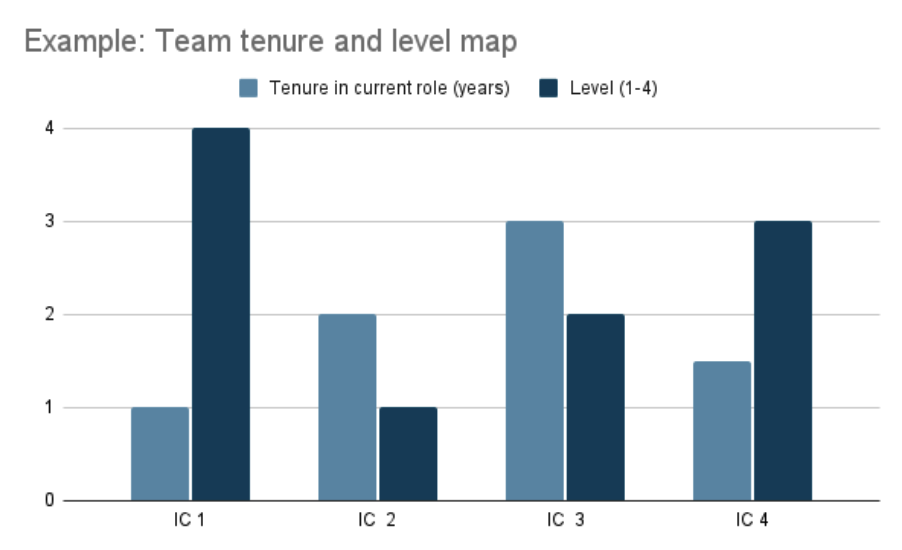
If you have an IC who is early in their role tenure and level from 1-2, you could consider having them expand a current project to have even more impact, improve on soft skills or hard skills or work with them to refine their performance in certain areas. This should in theory develop the IC and increase motivation.
If you have an IC that is 2+ years in the same role with a performance that isn’t strong enough for promotion, you should consider a career / work motivation exercise, from there you should be able to figure out what can best help them develop and have more positive reviews.
One piece to note here is the performance management piece cited earlier as well as general motivation etc.
If you have an high level IC with a 2/3+ year tenure with a strong performance, really digging into what they want to do next is key. Additionally, giving the IC more responsibility in terms of leadership tasks is always a good way to test whether they want to continue in the same area but have a leadership role (if you think they are a good fit and they want to pursue this path).
The 9 box grid model is also helpful for these exercises.
Know the Bullsh*tters
You know who I mean here. Know who they are, what their motivators are and give them a wide birth. When you do need to engage with them, be prepared. If their ‘bullsh*t’ starts affecting your team, step it, nip in the bud and move on.
Why are they worth ‘knowing’ ? Folks like this can affect your team and you. Better to identify them early and mitigate any risk their behavior brings.